
Completed Medicare Book Transition Case Study
How a Smaller Medicare Book Received a Structured, Personal Transition
One common misconception is that only large books merit a serious succession process. This completed transaction involved a single-carrier book of about 30 Medicare policies. Its size made individual communication practical; it did not change the standard of care.
The included book contained Medicare Advantage, Part D, and Medicare Supplement insurance, often called Medigap. The owner was stepping away from Medicare work and wanted the people he had served to have a dependable, responsive agency to call going forward.
Brickhouse used the same core operating disciplines it applies to every accepted book – verify, organize, introduce, serve, reconcile, and retain – through a tighter and more personal communication sequence.
This case illustrates Brickhouse’s approach to Medicare book succession.
By Matt Feret | Brickhouse Agency
Published · Updated
This range describes this transaction, not a valuation range or offer for another Medicare book. Exact terms remain private.
At a Glance
Anonymization disclosure. This case study is based on a completed Brickhouse Agency transaction. Seller and client names, carrier identities, geography, exact transaction dates, and other identifying details have been omitted or generalized. The purchase-consideration range is intentionally broad; exact financial terms remain private. Policy and asset counts are approximate and do not necessarily equal unique clients. Results are specific to this transaction and do not guarantee the outcome, timing, value, or transferability of another Medicare book.
- Book profile
- About 30 Medicare policies
- Carrier profile
- Single carrier
- Product profile
- Medicare Advantage, Part D, and Medicare Supplement/Medigap
- Owner objective
- Step away from Medicare work while giving clients a trusted, named service destination
- Primary challenge
- Transfer trust without creating fear, confusion, or an unnecessary sales event
- Brickhouse focus
- Direct seller introduction, welcome communication, mailed follow-up, individual call attempts, service readiness, and pre-AEP support
The Situation
The owner did not need a complicated public announcement or a large-scale change-management campaign. He needed a careful handoff that gave clients a clear introduction and a dependable person to contact.
That made the transition highly personal. A smaller book can magnify the importance of each individual interaction because the seller often knows the clients well, and the clients are more likely to notice whether the introduction feels authentic.
What the Owner Wanted
The owner wanted his clients to hear about the transition from him first. He wanted them to understand that their current coverage was not changing because of the handoff, that they did not need to take immediate action, and that he had deliberately selected Niki Feret and Brickhouse Agency to support them.
He also wanted a clean path for stepping away. Clients would know whom to call, Brickhouse would know whom it was responsible for, and the seller would not remain the permanent default service desk after the transaction.
The Same Standard, Tailored to a Smaller Book
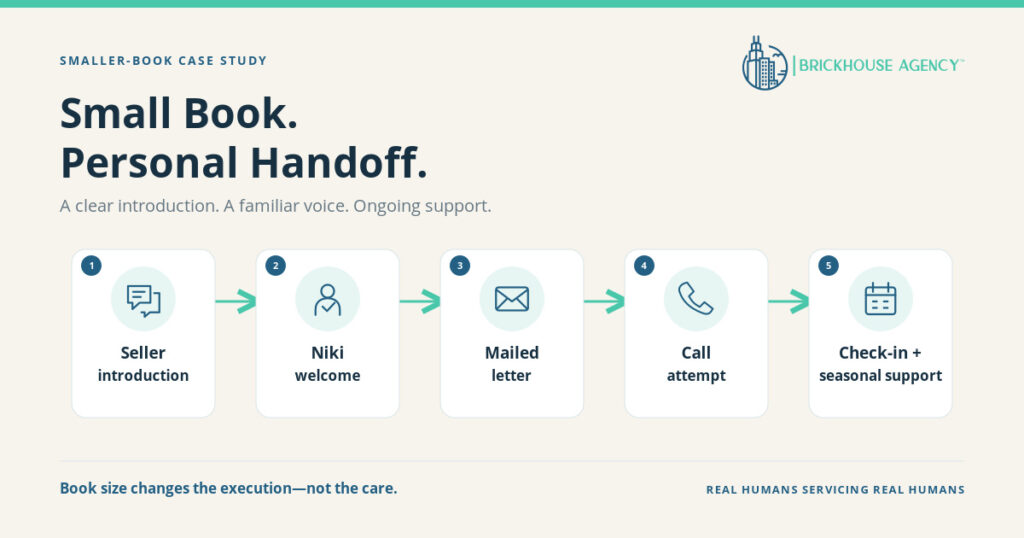
Brickhouse did not invent a lower service standard for a smaller transaction. The book entered the same operating framework used for larger transitions. The execution was simply designed around what the size made possible: individual seller messages, personal welcome communication, and a direct call attempt to each included policyholder.
A Medicare book does not have to be enormous to deserve a thoughtful succession process.
The Communication Sequence
1. The Seller Introduced Brickhouse First
The owner sent a personal message to the included clients before Brickhouse sent branded communication. The purpose was to transfer trust, explain why he had chosen Brickhouse, and give clients a familiar context for the emails, letter, or calls that would follow.
2. Niki Welcomed the Clients
Brickhouse followed with a welcome from Niki Feret. The message introduced the family-run Medicare agency, repeated that the clients’ current coverage was not changing because of the transition, and made the service contact easy to find.
3. A Mailed Letter Reinforced the Handoff
A physical welcome letter gave clients a durable reference with Brickhouse’s contact information. The letter was not a sales piece. It explained who would help with policy, billing, claims, prescription, benefits, notices, and other service needs.
4. Brickhouse Attempted Personal Welcome Calls
Because the book was small, Brickhouse could assign an individual welcome-call attempt to every included policyholder. Medicare Advantage and Part D clients were prioritized because the transition was approaching the seasonal period when notices and plan questions often increase. Medicare Supplement/Medigap clients were also included in the outreach plan.
5. Follow-Up Continued After the Introduction
The communication plan included a later check-in and a light pre-AEP touch. The purpose was not to manufacture appointments. It was to remind clients that help was available if they received a confusing notice or had a question about their existing coverage.
What the Initial Outreach Did Not Do
The first communication was not positioned as a sales call, a plan review, or a reason to replace coverage. It did not include a scheduling link or imply that the client needed to move carriers. Any future coverage discussion would have to be based on the client’s actual needs and handled through the normal compliant Medicare process.
- No surprise plan-change message.
- No pressure to schedule an appointment.
- No predetermined replacement objective.
- No handoff to an anonymous service queue.
- No assumption that silence meant the relationship would take care of itself.
Human Service After the Handoff
Clients were given a named Brickhouse service destination led by Niki and supported by the agency team. Brickhouse serves by phone, email, mail, and Zoom and can help with the ordinary issues that make an agent relationship valuable between enrollment periods – policy questions, billing, claims, prescriptions, benefits, notices, and general Medicare guidance.
The seller’s introduction was important, but it was not the end state. The end state was a functioning relationship in which clients knew that real people were available when they needed help.
Commission and Policy Accountability Still Mattered
A single-carrier book is easier to map than a large multi-carrier portfolio, but it still requires a confirmed policy list, transfer tracking, attribution, commission matching, and exception follow-up. Small does not mean invisible. Brickhouse identified the book separately so policy and payment activity could be monitored rather than absorbed into the agency without a clear baseline.
Why This Was Not a Passive Runoff Acquisition
A passive model could have stopped after the economic rights moved. Brickhouse’s work continued through seller communication, client welcome, mailed reinforcement, call attempts, service readiness, seasonal support, and policy and commission monitoring.
The book size changed the communication method. It did not change the belief underneath it: accepting a Medicare book means accepting responsibility for real client relationships.
Outcome
The completed transition gave the owner a defined path out of Medicare work and gave the included clients a clear, human service destination. The book was placed into Brickhouse’s operating and retention process rather than left as an unannounced renewal stream.
The owner was pleased with the communication and the care taken to introduce his clients. His support for the handoff reflected the central purpose of the transaction: the clients would know who had been chosen to help them and why.
Seller feedback, paraphrased
“I wanted my clients to hear about the change from me and to know I had chosen a team I believed would be responsive, dependable, and caring.”
Lessons for Other Owners of Smaller Medicare Books
- A smaller book still carries client relationships, recurring income, and the owner’s reputation.
- The right successor should be willing to discuss fit even when the book is too small for a large institutional process.
- The baseline operating standard should remain consistent, while the communication sequence is tailored to the book.
- A direct seller introduction can reduce confusion and improve the credibility of the new service relationship.
- Initial outreach should stabilize the relationship, not create a predetermined sales event.
- A single-carrier book still needs a source of truth, transfer tracking, commission matching, and service ownership.
Does Your Smaller Medicare Book Need a Responsible Home?
Brickhouse considers small, midsize, and more substantial independent Medicare books when there is a genuine fit. Size is one factor, not the only factor. Relationship quality, transferability, product mix, economics, owner participation, and the service needs of the clients all matter.
Already thinking seriously? Start a private conversation, or email Matt directly at [email protected] with the subject line “Medicare Book Conversation.” Do not send client-level information in the first message.
Frequently Asked Questions
Does Brickhouse consider smaller Medicare books?
Yes. Brickhouse may consider a smaller independent book when the relationships, economics, transferability, owner goals, and service needs fit the agency’s model. Brickhouse is selective, but it is not limited to institutional-size transactions.
Does a small book receive a different service standard?
No. Every accepted book enters the same core framework: verify, organize, introduce, serve, reconcile, and retain. The execution is tailored to the size and circumstances. A smaller book may make more individual communication practical.
How are clients introduced to the new agency?
The transition plan may begin with a personal seller message, followed by a Brickhouse welcome, mailed contact information, direct call attempts, and later service reminders. The sequence is developed before clients are redirected.
Are clients pressured to change plans after the transition?
No predetermined replacement objective is built into the handoff. The first outreach is about continuity and service. Any later coverage discussion must be needs-based, compliant, and appropriate to the client.
Is a single-carrier book easy to transfer?
It can be more straightforward than a multi-carrier portfolio, but the policy list, ownership, writing number, carrier process, service authority, commission activity, and client communication still need to be confirmed and tracked.
What service can Brickhouse provide after the handoff?
Brickhouse can help with policy questions, billing, claims, prescriptions, benefits, notices, annual or seasonal questions, and general Medicare guidance through phone, email, mail, and Zoom.
How does Brickhouse approach retention on a smaller book?
Retention begins with a credible introduction and a clear service destination. It continues through appropriate check-ins, seasonal communication, service follow-up, client history, and monitoring of the acquired book.
What should I send in a first email about a smaller book?
Send your name, state or primary market, approximate policy count, general product and carrier mix, expected timing, and what you are trying to accomplish. Do not send client names, Medicare numbers, dates of birth, health information, policy numbers, passwords, or portal credentials in the first message.
Related Completed Transitions
About Brickhouse Agency and Matt Feret
Brickhouse Agency is an independent, family-run, boutique Medicare agency serving Medicare-eligible clients in more than 35 states. Niki Feret leads the licensed agency and client-service operation. The agency’s transition model is built around real humans servicing real humans through structured communication, Medicare-trained support, retention work, client history, carrier follow-through, and commission reconciliation.
Matt Feret brings more than two decades of Medicare experience across carrier, distribution, executive, operational, and agency roles. He works directly with independent agents, agency owners, families, and firms considering Medicare book acquisitions, succession planning, and customized transitions.
Learn more: Brickhouse About page | Prepare for Medicare | The Matt Feret Show