
Completed Medicare Book Transition Case Study
A Complex Multi-Carrier Medicare Book Transition Beyond the Closing
Many owners think of a Medicare book as a single asset. Operationally, this completed transition was a collection of carrier, product, writing-number, client, service, and commission workstreams that had to be received one by one.
The anonymized book included more than 900 policy and asset records across multiple carrier relationships and product lines. That was not a unique-client count; some records represented more than one product or asset connected to the same person or household. The included business spanned Medicare Advantage, Medicare Supplement insurance, often called Medigap, prescription drug coverage, and related senior-market products.
The owner wanted to step away without leaving clients, carrier relationships, and recurring economics for someone else to reconstruct later. Brickhouse’s job was not only to complete the transaction. It was to create a workable operating transition.
Outcome: The former owner later referred another independent Medicare agent to Brickhouse.
This case illustrates Brickhouse’s approach to Medicare book succession.
By Matt Feret | Brickhouse Agency
Published · Updated
This range describes this transaction, not a valuation range or offer for another Medicare book. Exact terms remain private.
At a Glance
Anonymization disclosure. This case study is based on a completed Brickhouse Agency transaction. Seller and client names, carrier identities, geography, exact transaction dates, and other identifying details have been omitted or generalized. The purchase-consideration range is intentionally broad; exact financial terms remain private. Policy and asset counts are approximate and do not necessarily equal unique clients. Results are specific to this transaction and do not guarantee the outcome, timing, value, or transferability of another Medicare book.
- Book profile
- More than 900 included policy and asset records; not a verified unique-client count
- Carrier profile
- Multiple carrier relationships with different transfer and servicing requirements
- Product profile
- Medicare Advantage, Medicare Supplement/Medigap, Part D, and related senior-market products
- Owner objective
- Step away through an orderly transition that protected clients, reputation, and economic value
- Primary challenge
- Turning a signed transaction into carrier-by-carrier, record-by-record operational receipt
- Brickhouse focus
- Verification, data organization, client introduction, human service, commission reconciliation, and retention
The Situation
The book had been built over many years. Its value did not live in one spreadsheet or one monthly deposit. It existed across policy records, carrier statements, writing numbers, product histories, client relationships, and the owner’s accumulated knowledge of how the book actually worked.
The final transaction scope also had to distinguish the business being transitioned from other lines or assets that required a different path. That distinction mattered. A book of business is not automatically a transferable business, and a policy appearing in a CRM or on an old roster does not by itself prove current ownership, current commission rights, service authority, or transferable value.
What the Owner Wanted
The owner wanted a completed transition, not an indefinite consulting assignment and not a silent transfer that left clients wondering whom to call. The financial terms mattered, but so did three other outcomes: a clear handoff, confidence that clients would have real help, and confidence that the successor could account for what moved and what did not.
Who you transition your book to becomes part of your reputation.
Why the Book Could Not Be Treated as One Transaction
A signed purchase agreement can establish the parties’ rights and obligations. It does not make every carrier, writing number, commission stream, service designation, and client record move on the same date or through the same process.
Carrier requirements differ. A commission assignment may not always be identical to an agent-of-record or servicing transfer. Older business may sit under a different writing number from newer business. Some records may be current and transferable, while others need clarification, exclusion, or additional documentation. The only responsible way to receive a multi-carrier book is to break the work into identifiable dependencies and track each one to resolution.
How Brickhouse Approached the Transition
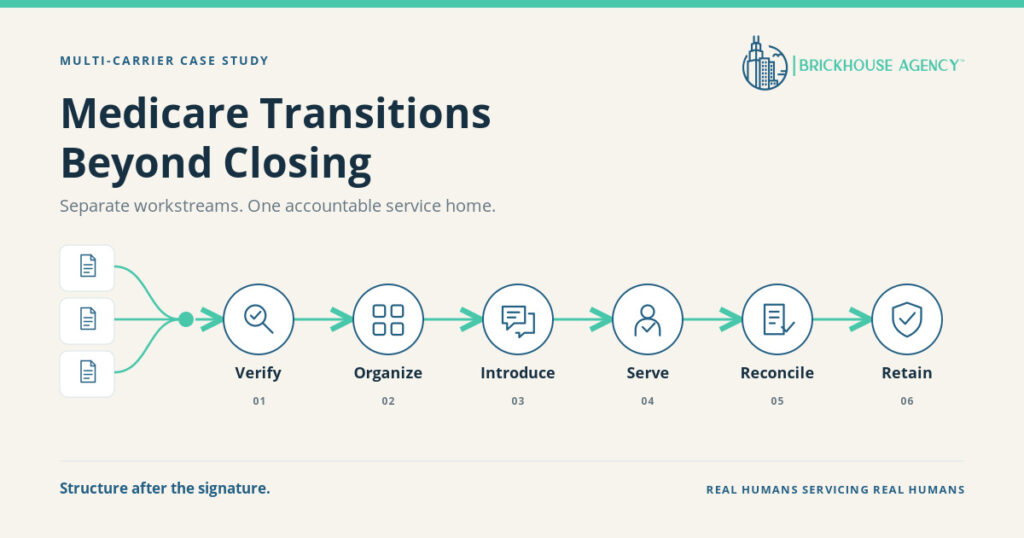
1. Verify the Economics and Transferability
Brickhouse reviewed commission history, carrier and product information, writing numbers, ownership, policy and asset records, and the intended transaction scope. The purpose was not merely to calculate a headline number. It was to understand what existed, what could be transferred, what required a separate path, and what risks had to be reflected in the structure.
2. Organize the Book for Another Agency to Operate
The records had to be converted into an operating source of truth. Policy and asset rows were organized by carrier, product, writing number, and status. Where practical, records were associated with client households so the book could be serviced as relationships rather than as an undifferentiated list of deposits.
3. Plan the Seller-to-Brickhouse Introduction
Client communication was planned before the announcement. The messaging had to explain what was changing, what was not changing, why the owner had selected Brickhouse, and how clients could reach the new service team. The transition also anticipated that some clients would continue contacting the former owner out of habit.
4. Establish a Functioning Service Destination
Niki Feret leads Brickhouse’s licensed agency and client-service operation. The transitioned relationships entered a Medicare-focused service model with named people, documented follow-up, phone and video support, and the ability to help with policy, billing, claims, prescription, benefit, and general Medicare questions. The service destination existed before clients were asked to rely on it.
5. Reconcile Expected and Actual Activity
Brickhouse tracked expected policy and commission activity against what actually appeared after the transition. Missing, reduced, delayed, or misdirected items were treated as exceptions to investigate. That work protected both the acquired economics and the accuracy of any later obligations tied to the book.
6. Retain Through Ongoing Service
The operating plan continued beyond the introduction. Appropriate annual communication, AEP or OEP outreach, service follow-up, education, client history, and book-level monitoring became part of the retention model. The objective was not to pressure clients into replacements. It was to prevent avoidable attrition caused by silence, confusion, or lack of service.
What the Legal Closing Did – and Did Not – Accomplish
Closing completed the transaction between the parties. It did not make every carrier dependency disappear. Some items can move quickly. Others require additional forms, confirmations, data work, or follow-up. A carrier submission is not the same as carrier confirmation, and a commission appearing in a bank account is not always proof that every service and attribution record is correct.
Because the post-close work had been assigned and tracked, those differences became operating exceptions to resolve rather than surprises that threatened the entire transition.
The contract transfers the asset. The operating system protects it.
Client Continuity Was Part of the Asset
The owner had spent years becoming the familiar person clients called when Medicare became confusing. Brickhouse could not preserve that relationship by changing a commission destination alone. The transition required a credible introduction, clear expectations, a known service contact, and a team prepared to answer the response.
This is also why the former owner remained relevant after closing. Clients may still see a former agent socially, call an old number, or ask whether the new agency is taking care of them. A responsible successor gives the former owner a truthful and comfortable answer.
Why Brickhouse Did Not Treat the Book as Passive Runoff
Some acquisition structures can be modeled primarily around receiving renewal cash flow and accepting attrition over time. That may be described financially as a “melting ice cube.” Brickhouse did not receive this book that way.
The renewal stream mattered, but it was inseparable from the people underneath it. Brickhouse received the book into an operating Medicare agency built to communicate, service, reconcile, monitor, and retain. The objective was to preserve both the economic asset and the client relationships that made the asset possible.
Outcome
The transaction was completed, and the book moved into Brickhouse’s post-close operating process. The former owner reported strong satisfaction with the communication, transition planning, and the way his former clients were being treated. Brickhouse also received positive feedback from former clients about the handoff and service experience.
Seller feedback, paraphrased
“Brickhouse kept me informed and handled the transition the way I hoped. I felt good about how my former clients were being treated.”
The Referral That Mattered
The strongest endorsement came after the owner had experienced the process himself. He later referred another independent Medicare agent to Matt Feret and Brickhouse because that agent was also looking for a responsible home for his book.
That referral carried more weight than a generic testimonial. The former owner had seen the transition, watched how Brickhouse communicated with clients, and remained comfortable attaching his own reputation to the introduction.
The strongest endorsement of a succession process may be when the former owner recommends the successor to another agent.
Lessons for Other Medicare Agency Owners
- A multi-carrier Medicare book is a portfolio of separate transfer and service dependencies, not one uniform transaction.
- Policy or asset records should not be confused with unique clients or automatically treated as verified value.
- Commission assignment, agent-of-record status, service authority, and carrier processing may require different steps.
- The successor needs operating capacity before the announcement, not after client calls begin.
- Book-level commission reconciliation matters whenever payment, holdbacks, deferred obligations, or performance monitoring continue after closing.
- The owner should diligence the successor’s service model and accounting capability as seriously as the successor diligences the book.
Planning a Complex Medicare Book Transition?
Your book will have its own carriers, products, writing numbers, records, client expectations, and owner goals. The first question is not “What is my multiple?” It is “What am I actually trying to accomplish?” Brickhouse begins with a private fit-and-goals conversation, not a promise that every book will receive an offer.
Already thinking seriously? Start a private conversation, or email Matt directly at [email protected] with the subject line “Medicare Book Conversation.” Do not send client-level information in the first message.
Frequently Asked Questions
Is a Medicare book transfer one transaction?
Legally, the parties may complete one asset transaction. Operationally, a multi-carrier book usually requires separate carrier, writing-number, commission, service-authority, roster, and communication workstreams. Those dependencies can finish on different timelines.
What does “more than 900 policy and asset records” mean?
It is the approximate number of included records in the transaction scope. It is not presented as a unique-client count. One person or household may have more than one product, policy, or asset record.
Are commission assignment and agent-of-record status always the same?
No. The answer varies by carrier and product. In some situations, the right to receive commissions and the authority or designation to service the client require separate forms or confirmations. Each carrier path must be verified.
What happens immediately after a Medicare book closes?
The legal transaction is followed by operational receipt: carrier submissions and confirmations, secure data transfer, client communication, service readiness, commission matching, exception resolution, and retention monitoring.
How does Brickhouse handle missing or misdirected commissions?
Brickhouse compares expected activity with actual statements and deposits, isolates exceptions, and follows the relevant carrier or hierarchy path. The purpose is to understand whether the issue is timing, a writing number, a policy status, a compensation change, or another transfer problem.
Does Brickhouse consider larger or more complex Medicare books?
Yes, when there is a genuine fit among the book, clients, owner, transferability, economics, and Brickhouse’s service capacity. Brickhouse is selective and does not accept complexity simply to accumulate policy count.
Will transitioned clients be sent to a generic call center?
Brickhouse is an operating Medicare agency. Niki Feret leads the licensed agency and client-service operation, supported by Medicare-trained people, documented follow-up, phone and video support, and a structured communication and retention model.
How should an owner evaluate a potential successor?
Ask who will actually service the clients, how the book will be identified and reconciled, how carrier exceptions will be handled, whether later payments can be audited, and what clients will experience one month, one year, and several years after the transition.
Related Completed Transitions
About Brickhouse Agency and Matt Feret
Brickhouse Agency is an independent, family-run, boutique Medicare agency serving Medicare-eligible clients in more than 35 states. Niki Feret leads the licensed agency and client-service operation. The agency’s transition model is built around real humans servicing real humans through structured communication, Medicare-trained support, retention work, client history, carrier follow-through, and commission reconciliation.
Matt Feret brings more than two decades of Medicare experience across carrier, distribution, executive, operational, and agency roles. He works directly with independent agents, agency owners, families, and firms considering Medicare book acquisitions, succession planning, and customized transitions.
Learn more: Brickhouse About page | Prepare for Medicare | The Matt Feret Show