
Completed Medicare Book Transition Case Study
A Family-Guided Medicare Supplement (Medigap) Book Succession
More than 80% of the book’s policy records were Medicare Supplement insurance, often called Medigap. This completed single-carrier transition involved about 110 policy records, and the longtime agent’s adult son participated in helping the family understand and plan for what would happen next.
The situation was not only financial. The owner had built longstanding client relationships. The family needed clarity about the book, the records, the transferable rights, the practical work of a transition, and who would be responsible for the clients after the owner stepped away.
Brickhouse worked through the book as both an economic asset and a human succession responsibility. The result was a completed transition into an operating Medicare agency rather than a plan that depended on the family reconstructing everything during an emergency.
This case illustrates Brickhouse’s approach to Medicare book succession.
By Matt Feret | Brickhouse Agency
Published · Updated
This range describes this transaction, not a valuation range or offer for another Medicare book. Exact terms remain private.
At a Glance
Anonymization disclosure. This case study is based on a completed Brickhouse Agency transaction. Seller and client names, carrier identities, geography, exact transaction dates, and other identifying details have been omitted or generalized. The purchase-consideration range is intentionally broad; exact financial terms remain private. Policy and asset counts are approximate and do not necessarily equal unique clients. Results are specific to this transaction and do not guarantee the outcome, timing, value, or transferability of another Medicare book.
- Book profile
- About 110 policy records; not necessarily a unique-client count
- Carrier profile
- Single carrier
- Product profile
- More than 80% of policy records were Medicare Supplement/Medigap, with a smaller Medicare Advantage and Part D component
- Owner/family situation
- Longtime agent and adult son working through the future of the book
- Primary challenge
- Create family clarity and reconstruct a reliable transition path from imperfect records and limited access
- Brickhouse focus
- Ownership and transferability review, record organization, family decision clarity, client continuity, service setup, and commission monitoring
The Family Situation
A Medicare book can become a family responsibility even when only the agent understands how it operates. Commission statements may arrive each month, but the family may not know which policies are active, which rights are transferable, which carrier forms are required, where the records live, or what clients expect from the relationship.
In this case, the adult son helped his father think through the future of the book. That family participation was valuable because succession decisions often involve more than the agent. A spouse, child, partner, or estate may eventually be affected by the outcome even when that person did not build or service the book.
What the Owner and Family Wanted
The family wanted a responsible and understandable path. They needed to know what was actually in the book, what the owner controlled, what could be transitioned, what information was missing, what the clients would experience, and how the economic value could be preserved without leaving the service burden to an unprepared relative.
Planning before an emergency allowed the owner to participate in the decision, answer questions, help validate the records, and choose the successor. That is a materially different position from asking a family to solve the same issues after disability or death.
A succession plan is not a decision to leave. It is a decision not to leave a mess – for the clients or the family.
Why a Medigap-Heavy Book Requires Its Own Analysis
Medicare Supplement and Medigap books can be durable, relationship-based assets, but durability is not automatic. Value depends on the age and status of the policies, commission schedules, product and state rules, carrier treatment of replacements, client relationships, service expectations, and whether the economic and servicing rights can be transferred cleanly.
Medigap clients also do not follow the same annual pattern as Medicare Advantage clients. Appropriate service may include help with premiums, billing, claims, carrier notices, underwriting questions, guaranteed-issue or open-enrollment situations, and decisions about whether a change is actually in the client’s interest. A responsible successor does not force an annual replacement rhythm onto a Medicare Supplement book simply because AEP exists for other Medicare products.
Single Carrier Did Not Mean Simple
The book was concentrated with one carrier, but the records included different products, policy vintages, statuses, and commission characteristics. The carrier export, commission statements, and the family’s understanding did not automatically become one clean operating roster.
Brickhouse had to determine which records belonged in the transaction scope, distinguish current and uncertain items, verify ownership and transferability, and understand how the carrier would handle both commissions and service authority. The work was narrower than a multi-carrier transition, but it still required disciplined reconstruction.
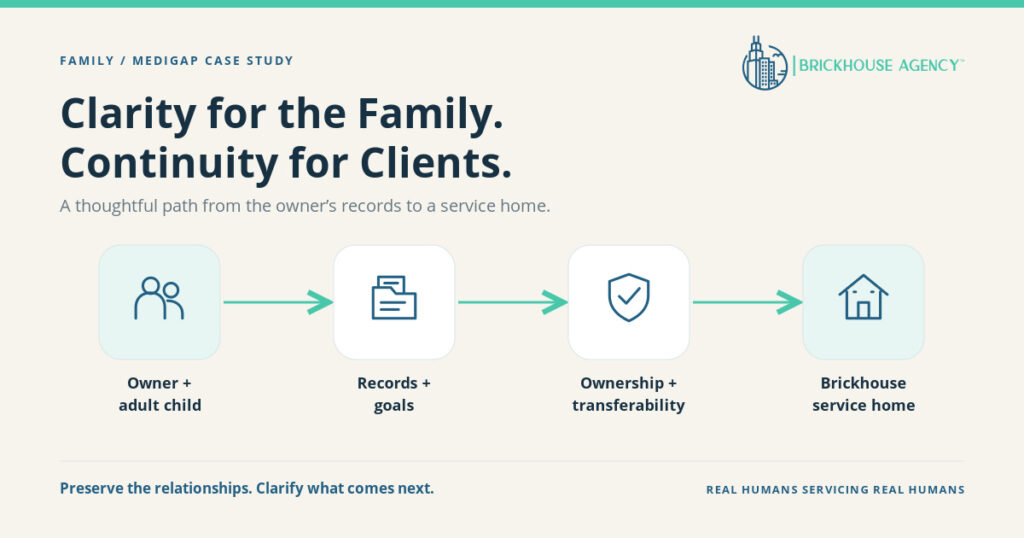
How Brickhouse Reconstructed the Transition Path
1. Gather the Available Evidence
Brickhouse worked from the available carrier exports, commission statements, policy records, and owner knowledge. The purpose was to create a reliable baseline without pretending that one source was complete simply because it looked official.
2. Classify the Book
The policy records were classified by Medicare Supplement/Medigap, Medicare Advantage, and Part D, with status and product differences identified for follow-up. That made it possible to understand the dominant Medigap economics while also planning appropriately for the smaller annual-plan component.
3. Confirm Ownership and Transferability
The transition required a clear understanding of who owned or controlled the economic and servicing rights, which carrier forms were required, and what obligations would continue after signing. Family involvement supported the process, but the legal and carrier path still had to be documented through the appropriate owner and agency parties.
4. Define the Client-Service Destination
The family needed more than a buyer willing to receive commissions. The clients needed a real Medicare agency home. Niki and the Brickhouse team would become the service destination, with a planned introduction, documented records, Medicare-specific support, and follow-up appropriate to the product mix.
5. Monitor the Economic Transition
Brickhouse established a book-level baseline so commission activity could be compared with the records expected to move. That was important for confirming the economic transfer, identifying exceptions, and preserving transparency around the completed transaction.
Client Continuity in a Longstanding Medigap Book
Many of the relationships had existed for years. The clients knew the original agent, not merely the carrier. The transition therefore had to preserve the human context: why the change was happening, who had been selected, how to reach Brickhouse, and what kind of help would remain available.
For Medicare Supplement/Medigap clients, the service plan centered on continuity and needs-based help rather than a predetermined replacement campaign. The smaller Medicare Advantage and Part D segment could receive the seasonal communication and review support appropriate to annual plans. One book required more than one retention rhythm.
Why the Family Needed More Than a Passive Commission Transfer
A passive runoff structure might have addressed where the renewal cash flow went. It would not necessarily have answered who would communicate with the clients, resolve service issues, monitor carrier movement, or preserve the owner’s reputation.
Brickhouse’s role was to receive the relationships into an operating Medicare agency. The family gained a defined successor, the owner retained a voice in the handoff, and the clients gained a service destination that did not depend on the son or another relative becoming the accidental operator of the book.
Outcome
The transaction was completed with an agreed book scope and a defined path for client and carrier transition. The family gained greater clarity about the asset, the records, and the responsibilities that would continue after signing. The book entered Brickhouse’s service and commission-monitoring process rather than remaining an informal family problem waiting for a crisis.
The owner and family expressed satisfaction with the clarity, communication, and responsible path created for the clients.
Seller/family feedback, paraphrased
“The process gave our family a clearer understanding of the book and a responsible path for the clients.”
Lessons for Other Medicare Agents and Families
- A Medicare book may be a family asset even when family members are not prepared to own or operate a Medicare agency.
- Planning before disability, death, or an urgent retirement allows the owner to choose the successor and help validate the records.
- A Medigap-heavy book should be evaluated on its actual policy and commission characteristics, not by applying a generic Medicare multiple.
- Single-carrier concentration reduces some coordination, but it does not eliminate ownership, status, service-authority, or commission questions.
- Messy records can often be organized. Hidden ownership, undisclosed restrictions, and missing economic facts are more expensive problems.
- The family should diligence the successor’s service model, carrier knowledge, and ability to account for the economics.
Create Clarity Before Your Family Has to Act Under Pressure
You do not need a perfect data room, a final retirement date, or a family member ready to run the agency before beginning a private conversation. Start with the approximate book size, principal products and carriers, the people involved in the decision, and what you most want to protect.
Already thinking seriously? Start a private conversation, or email Matt directly at [email protected] with the subject line “Medicare Book Conversation.” Do not send client-level information in the first message.
Frequently Asked Questions
Can an adult child help a parent plan a Medicare book succession?
Yes. A family member can help gather information, clarify goals, participate in conversations, and support the owner’s decision process. Ownership, authority, licensing, contracts, and carrier requirements still have to be reviewed for the actual transaction.
Does a child need an insurance license to participate?
A family member may participate in planning without becoming the servicing agent. The ability to solicit, advise, service, own contractual rights, receive commissions, or execute a transfer depends on the person’s role, licensing, legal authority, entity structure, and carrier rules. Those questions should be addressed with the appropriate legal and carrier professionals.
What happens if an agent dies before creating a succession plan?
The family or estate may have to locate contracts, commission statements, writing numbers, policy records, credentials, tax documents, and legal authority while also dealing with carrier deadlines and client needs. The outcome depends on the contracts and ownership structure. A documented plan created in advance preserves more options.
How is a Medicare Supplement or Medigap book valued?
The analysis may include verified commission history, policy age and status, commission schedules, product and state rules, carrier concentration, persistency, client relationships, data quality, transferability, service needs, and current market risk. Policy count alone is not value.
Does one carrier make a succession simple?
It can reduce the number of transfer workstreams, but it does not eliminate the need to verify the policy roster, ownership, writing number, service authority, commission rights, policy status, product differences, and client communication.
What if the records are spread across statements, spreadsheets, paper files, and memory?
That is common. The first conversation can stay high level. A completed transition will eventually require enough verifiable information to establish the book scope, economics, ownership, transferability, and client-service obligations.
What happens to Medigap clients after the transition?
The clients receive a new service destination and an explanation of the handoff. Ongoing help may include billing, claims, premiums, carrier notices, underwriting or guaranteed-issue questions, and needs-based coverage guidance. The transition is not a pretext for automatic replacement.
What should a family gather first?
Begin with recent commission statements, carrier and product lists, approximate policy counts, writing numbers or agency names, entity and ownership information, known contracts, key contacts, the owner’s desired timeline, and the names of the people who should participate. Do not send client-level information before confidentiality and secure transfer methods are in place.
Related Completed Transitions
About Brickhouse Agency and Matt Feret
Brickhouse Agency is an independent, family-run, boutique Medicare agency serving Medicare-eligible clients in more than 35 states. Niki Feret leads the licensed agency and client-service operation. The agency’s transition model is built around real humans servicing real humans through structured communication, Medicare-trained support, retention work, client history, carrier follow-through, and commission reconciliation.
Matt Feret brings more than two decades of Medicare experience across carrier, distribution, executive, operational, and agency roles. He works directly with independent agents, agency owners, families, and firms considering Medicare book acquisitions, succession planning, and customized transitions.
Learn more: Brickhouse About page | Prepare for Medicare | The Matt Feret Show